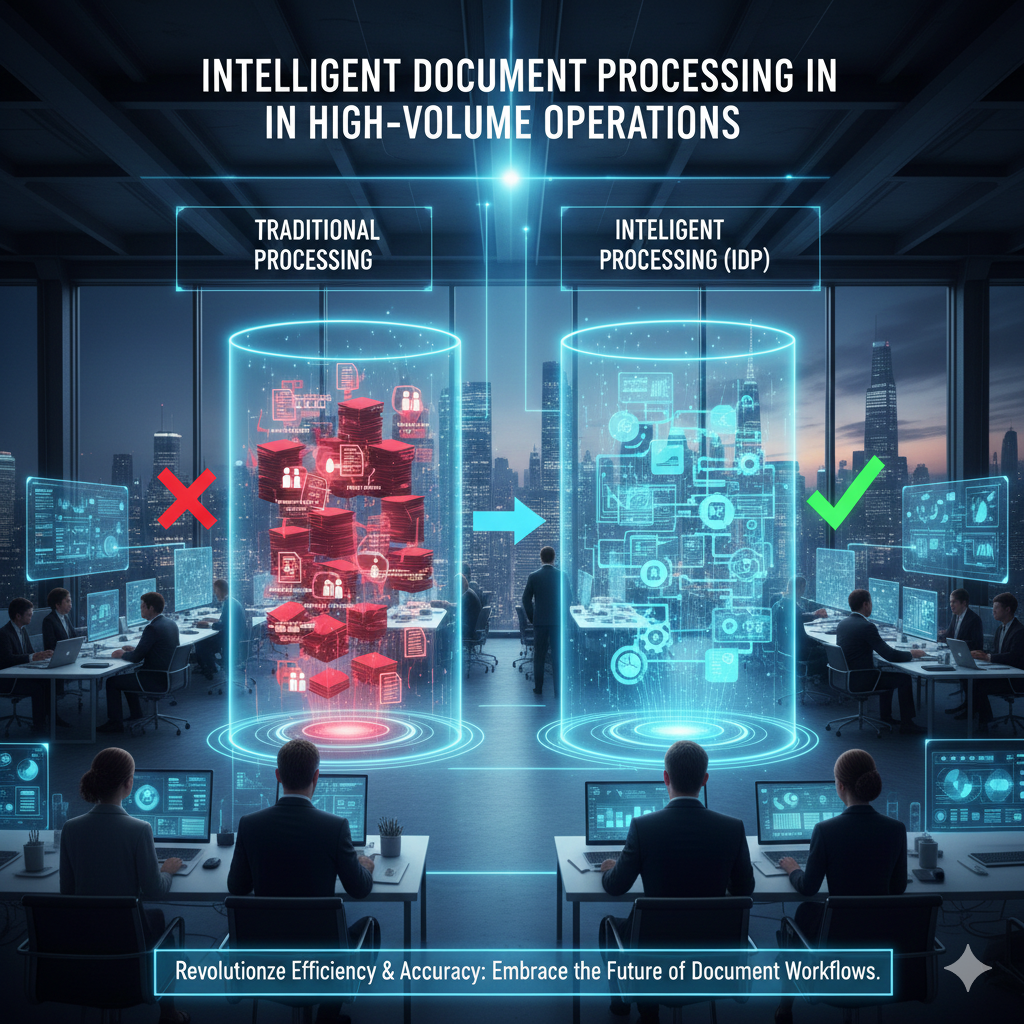
Organizations that handle thousands or even millions of documents each month face a unique operational challenge. Invoices, forms, claims, applications, and correspondence arrive constantly, often in different formats and from multiple channels. Intelligent Document Processing has become a critical capability in these high-volume operations because it turns unstructured documents into usable data quickly and accurately. Without it, manual processing slows teams down, increases errors, and drives up operational costs.
As document volumes grow, speed alone is not enough. Accuracy, traceability, and scalability matter just as much. Intelligent processing addresses all three, making it a foundational component of modern operations.
Why High-Volume Environments Need Automation
High-volume operations break manual workflows first. When document intake spikes, teams rely on overtime, temporary staff, or backlogs to cope. According to data from AIIM, organizations that process documents manually average error rates between 1 percent and 5 percent. At scale, even a small error rate translates into thousands of incorrect records.
Intelligent Document Processing uses machine learning, optical character recognition, and rules-based logic to capture and classify documents automatically. Instead of keying in data line by line, systems extract relevant fields and validate them against predefined criteria. This reduces dependency on manual labor while maintaining consistency.
For example, a large accounts payable team may receive tens of thousands of invoices each month. With automation in place, invoices are recognized, data is extracted, and exceptions are flagged instantly. According to Deloitte, organizations using intelligent automation in finance reduced processing time by up to 70 percent. These gains allow teams to focus on exception handling rather than routine data entry.
Scalability is another factor. Manual processes struggle during seasonal spikes or business growth. Automated document processing adjusts to volume changes without the need for proportional increases in staff. This flexibility is especially valuable in industries like logistics, insurance, and utilities.
Accuracy, Speed, and Operational Consistency
Speed and accuracy often compete in manual environments. Faster processing increases the risk of mistakes, while careful reviews slow everything down. Intelligent Document Processing removes this tradeoff by applying the same logic consistently at scale.
Machine learning models improve over time by learning from corrections and feedback. As accuracy increases, exception rates drop. A study by Accenture found that intelligent document solutions achieved accuracy levels above 90 percent after initial training periods. This level of consistency is difficult to maintain with human-only workflows, especially under pressure.
Operational consistency also improves. Documents are routed automatically based on content, priority, or business rules. This ensures that urgent cases move faster and standard cases follow predictable paths. Managers gain confidence that processes are executed the same way across teams and locations.
This consistency supports service level commitments. When processing times are predictable, organizations can set realistic expectations with customers and partners. Meeting these expectations builds trust and reduces follow-up inquiries that further burden operations.
Cost Control and Workforce Impact
High-volume document handling is expensive when done manually. Labor costs rise quickly, and error correction adds hidden expenses. Intelligent Document Processing reduces these costs by shifting work from repetitive tasks to automated systems.
According to PwC, intelligent automation initiatives can reduce operational costs by 20 percent to 30 percent in document-heavy functions. These savings come from faster processing, lower error rates, and reduced rework. Over time, the return on investment becomes clear as volumes increase.
The workforce impact is often misunderstood. Automation does not eliminate the need for people. It changes how people spend their time. Staff move away from routine data entry and toward oversight, analysis, and customer interaction. This shift improves job satisfaction and reduces burnout in high-pressure environments.
Training requirements also decrease. New employees no longer need to memorize complex document rules. Automated systems enforce those rules consistently, making onboarding faster and less error-prone.
Visibility, Compliance, and Control
High-volume operations demand visibility. Without it, bottlenecks and risks remain hidden until problems escalate. Intelligent Document Processing provides real-time insights into document flow, processing times, and exception rates.
These insights support continuous improvement. If a certain document type consistently causes delays, teams can adjust models or rules based on data rather than assumptions. Harvard Business Review noted that data-driven operations respond to issues faster and make more effective process improvements.
Compliance is another critical area. Automated document processing creates audit trails that show when documents were received, processed, and approved. This traceability is essential in regulated industries. According to EY, organizations with automated document controls reduced audit preparation time by nearly 50 percent.
Security controls can also be applied consistently. Sensitive documents are handled according to predefined access rules, reducing the risk of unauthorized exposure. This level of control is difficult to achieve when documents are handled manually across multiple teams.
Conclusion
High-volume operations leave little room for inefficiency or error. Intelligent Document Processing has proven to be a practical solution for managing large document flows with speed, accuracy, and consistency. By automating capture, classification, and data extraction, organizations reduce costs, improve compliance, and gain visibility into their operations. As document volumes continue to rise, investing in intelligent processing is a strategic step toward building scalable and resilient workflows that can keep pace with demand.

 Everywhere
 Members
 Albums